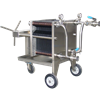
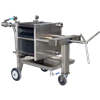
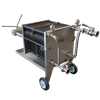
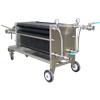
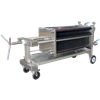
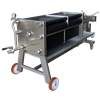
40x40 Plate & Frame Filters

40x40 Plate & Frame Filters aka Sheet Filters

Depth filtration (sometimes referred to as “bulk filtration”) does the heavy lifting. This is done by running product through a series of filter media, usually with a Plate and Frame Filter (sometimes called a “Sheet Filter”) or a Lenticular Filter. When depth filtering, product is typically run through the filter multiple times, decreasing the micron rating (porosity) of the filter media with each pass.

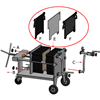
A plate and frame filter utilizes a series of fibrous filter sheets sandwiched between plates (typically a food-grade plastic or stainless-steel) that are channeled to allow product to flow through the filter sheets from the inlet side of the plate to the outlet. The plates and sheets are pressed tightly together to minimize dripping / product loss as the filter sheets fill with product. Filter sheets are relatively inexpensive, so there’s little financial risk in experimenting with different filter grades. The drawback of a plate filter is that product is exposed oxygen and outside “contaminants” while it is being filtered and, as the filter sheets fill up, product is lost due to dripping.

Plate and Frame / Sheet Filters is one of the most common filtrations process for Olive Oil and Wine.


Sheet Filtration Process for Wine
  • Method: A plate-and-frame system forces wine through pads using pressure, removing yeast, bacteria, and colloids.
  • Setup: Sheets are arranged with alternating inflow and outflow plates. The rough side of the sheet faces the inlet to prevent clogging.
  • Types of Filtration: Covers rough filtration (large particles), polishing (brightening), and fine/sterile filtration (removing microbes).
  • Setup: A diverter aka Cross Over Plate can allow for two-stage filtration in one pass (e.g., polishing followed by sterile filtration). 

Sheet Filtration Process for Olive Oil
  • Importance: Removes residual water and microscopic solids to prevent turbidity, anaerobic fermentation, and enzymatic degradation of the oil.
  • Technique: Similar to wine, cellulose-based depth filter sheets are used to entrap impurities, which maintains the oil’s aroma and flavor.
  • Equipment: Specialized stainless steel plate filters are commonly used to filter oil while maintaining its organoleptic properties. 

Key Considerations
  • Pressure: Monitor the pressure difference (differential pressure) to know when sheets are saturated and need replacement.
  • Rinsing: Filter sheets must be rinsed with water to remove any manufacturing particles and sometimes sterilized with hot water or steam prior to use.
  • Flow Rate: Flow should typically be between 1 to 2 bars (14.5 PSI per bar).